Kimo Adiebo Consulting · Ottawa, Ontario, serving internationally
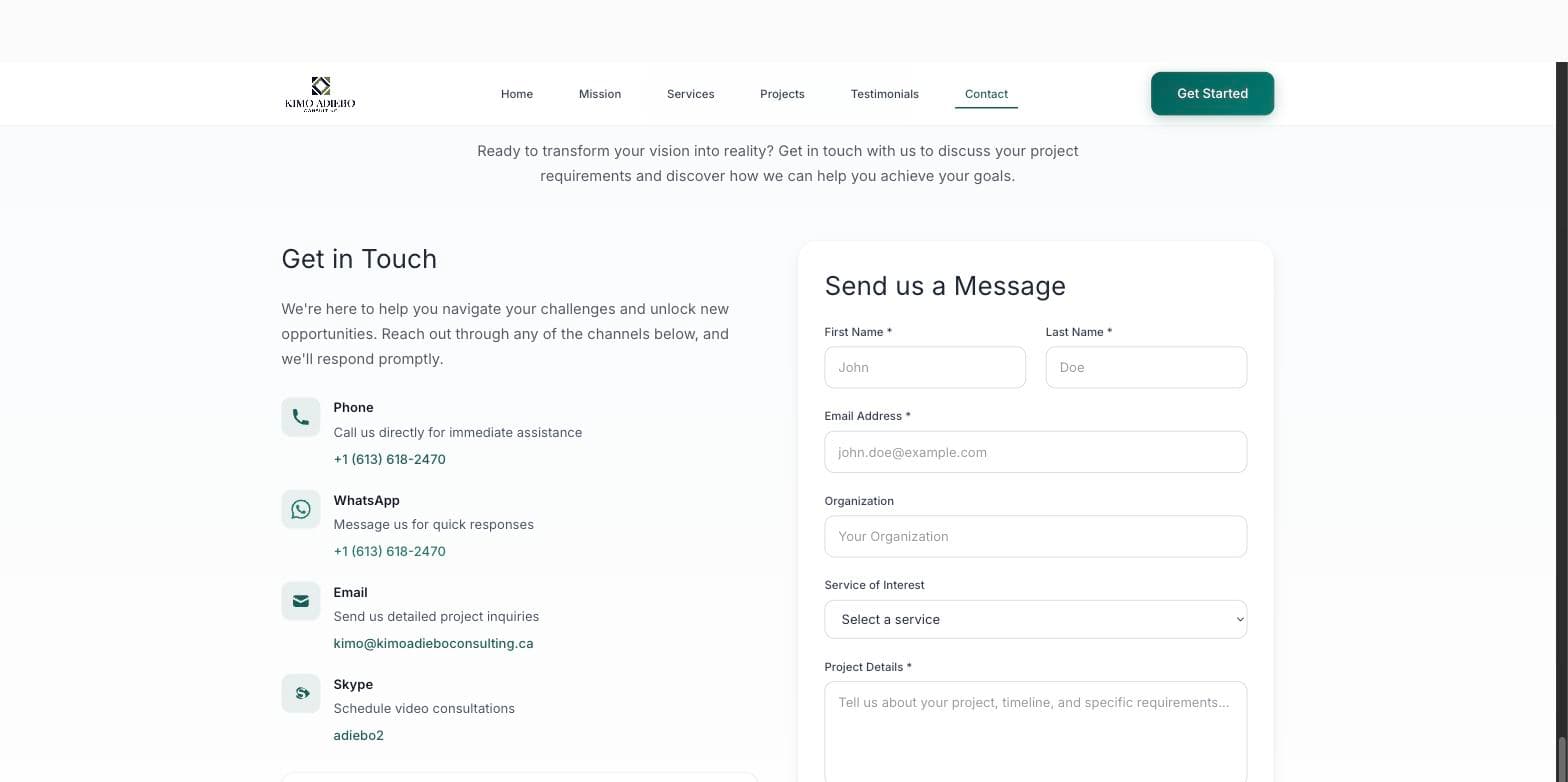
Four contact channels, each labelled with what it is for
A project management consultancy serving clients across borders. The enquiry path routes by purpose rather than offering one form, and the form itself qualifies before anyone replies.
- Client
- Kimo Adiebo Consulting
- Industry
- Project management and strategy consulting
- Location
- Ottawa, Ontario, serving internationally
- Services
- Website design · Conversion rate optimization · Copywriting
Consulting sells the same way everywhere: someone decides you are credible, then they decide whether to start a conversation.
The complication here is distance. Kimo Adiebo Consulting works with organisations across borders, which means a meaningful share of prospective clients will never dial a Canadian number and are in a timezone where a phone call is the wrong opening move.
A single contact form assumes everyone is comfortable with the same channel. Most of the time that assumption is invisible, because the people it excludes simply leave.
Route by purpose, not by preference
The contact section offers four channels, and each one carries a line saying what it is for:
- Phone, for immediate assistance
- WhatsApp, for quick responses
- Email, for detailed project inquiries
- Skype, for scheduled video consultations
The labels are the whole point. A list of four icons makes a visitor choose without information, and an uncertain visitor defaults to the lowest-commitment option or to nothing. Telling them which channel suits their situation turns a choice into a instruction.
WhatsApp in particular is not decoration. For a consultancy working internationally it is the default business channel across large parts of the world, and its absence quietly filters out those clients.
The form qualifies before anyone replies
Alongside the channels, the enquiry form asks for organisation, service of interest, and project details rather than a single open message box.
Service of interest is a defined list covering programme evaluation, strategic planning, professional development, socioeconomic and environmental impact, research and policy, business innovation, and a custom option. Consulting engagements diverge enormously in scope, and knowing which one is being asked about changes the entire shape of the first reply.
The project details field prompts for timeline and specific requirements rather than saying "message". That is the difference between a reply that asks four clarifying questions and a reply that engages with the actual work.
Organisation is the quiet one. For B2B, it tells you whether the enquiry is a government department, a small non-profit, or a private firm, and that shapes the response before a word is written.
Credibility above the fold
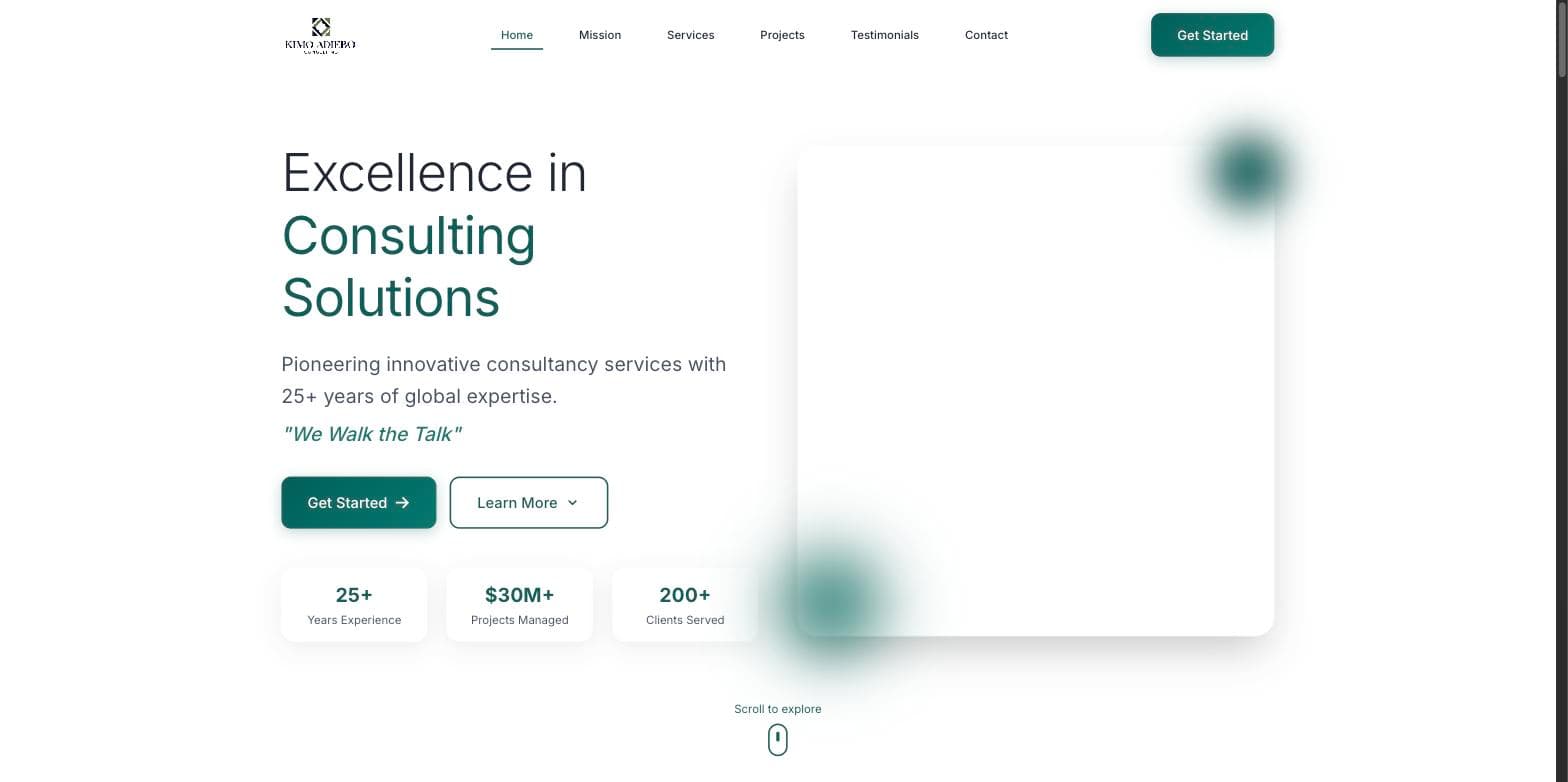
The hero carries three figures directly under the opening statement: years of experience, value of projects managed, and clients served.
For a services business with no physical product, that block is the proof. A consultancy is asking a buyer to trust judgement they cannot inspect in advance, and the numbers are the shortest available answer to "should I take this seriously".
The tagline underneath does the same job in a different register, and it is the client's own line rather than something written for them.
Design decisions
Deep green and white with generous whitespace, which is the visual language institutional buyers already read as considered. Nothing hurried, nothing loud.
The navigation runs Mission, Services, Projects, Testimonials, Contact, in the order a cautious buyer actually evaluates a firm: what they stand for, what they do, what they have done, who vouches for them, and only then how to reach them.